
Optics Express · 2020
High-spatial-resolution counterflow-flame thermometry with one laser
Spatially and temporally resolved temperature measurements in counterflow flames using a single interband cascade laser
Accurate, fast thermometry is essential for understanding combustion and evaluating reaction mechanisms. This work develops spatially and temporally resolved measurements with a single laser to characterize counterflow flames.
The motivation
Counterflow flames provide controlled environments for studying combustion chemistry and pollutant formation. Their steep temperature gradients and hot, sooting regions challenge conventional probes. Non-intrusive absorption thermometry must resolve these gradients while accounting for temperature non-uniformity along the optical path.
The approach
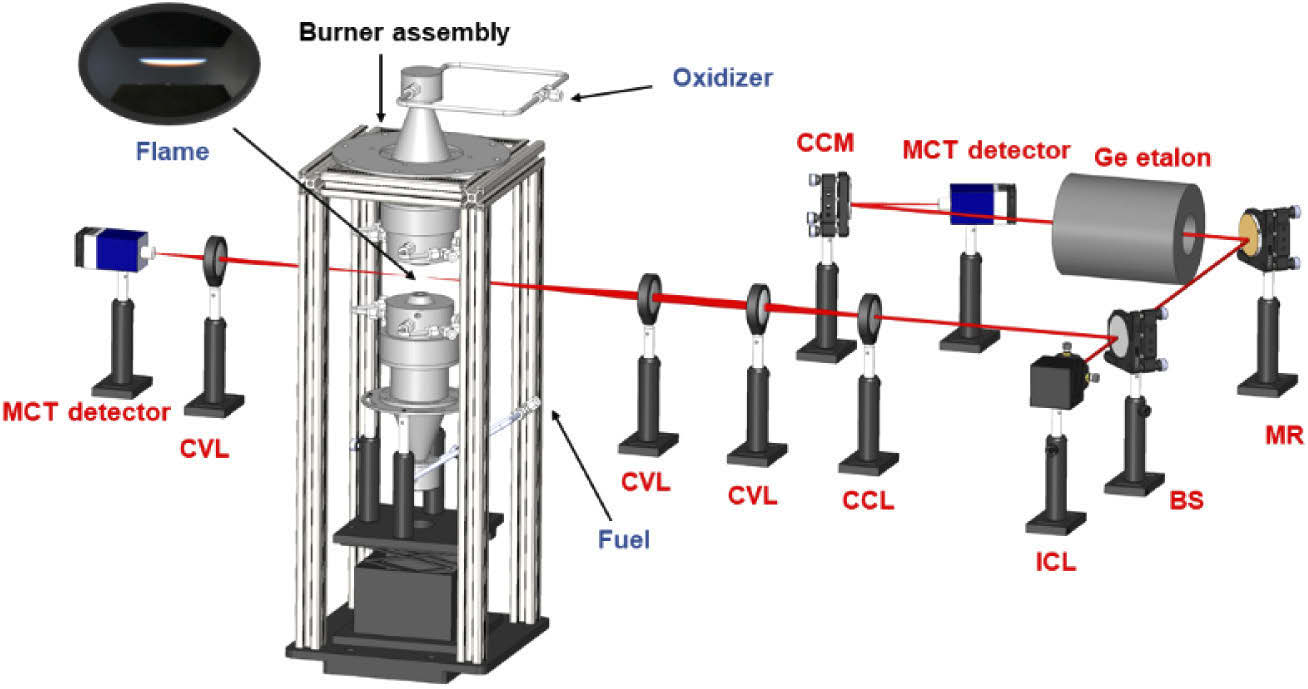
A single interband cascade laser scans CO2 absorption lines near 4.2 μm, with a beam diameter of approximately 150 μm FWHM at the flame axis. Hyperspectral tomography and multiline thermometry with radial profile fitting are applied to axisymmetric counterflow flames; 5 kHz scans also support exploration of instantaneous thermometry.
Key findings
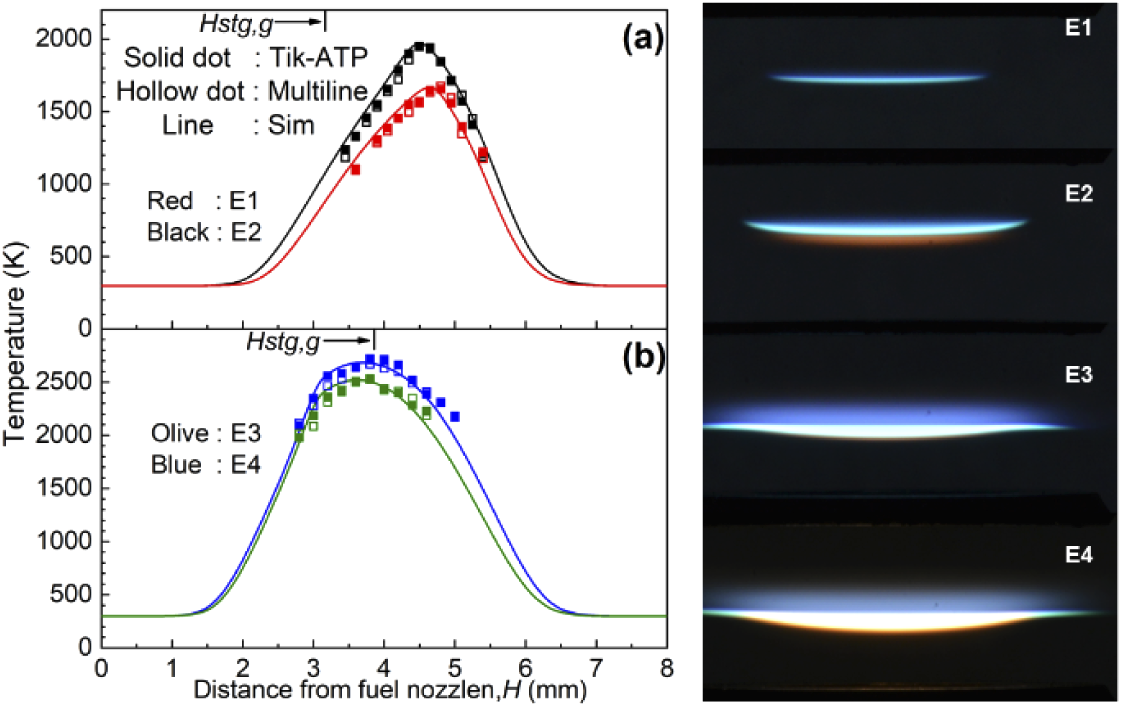
- Four counterflow flames spanning non-sooting, soot-formation and soot-formation/oxidation conditions yielded peak temperatures of 1654–2720 K. Measured axial temperature profiles agreed with corresponding numerical predictions.
- Tomographic and multiline results agreed in the hot core, supporting treatment of line-of-sight non-uniformity. The selected transitions provide weaker constraints on temperature reconstruction in the cooler flame-edge region.
- Single-scan thermometry at 0.2 ms sampling intervals was validated in essentially steady flames. Numerical virtual experiments further assessed its applicability to millisecond flame transients.
About this paper
Optics Express · 2020 · 28(25) · 37879–37902
Publisher record (DOI)