
Measurement Science and Technology · 2023
Online laser monitoring of ammonia slip in humid flue gases
A laser absorption sensor for fuel slip monitoring in high-humidity flue gases from ammonia combustion
Clean ammonia use requires control of both combustion efficiency and unburned fuel emissions. Online laser sensing in humid exhaust provides real-time information for industrial-furnace optimization and emissions control.
The motivation
Unburned ammonia affects both fuel utilization and emissions when ammonia is used for industrial heating. Reliable exhaust measurements can guide combustion and after-treatment operation. High water-vapor levels, together with condensation and adsorption during sampling, make accurate online detection challenging.
The approach
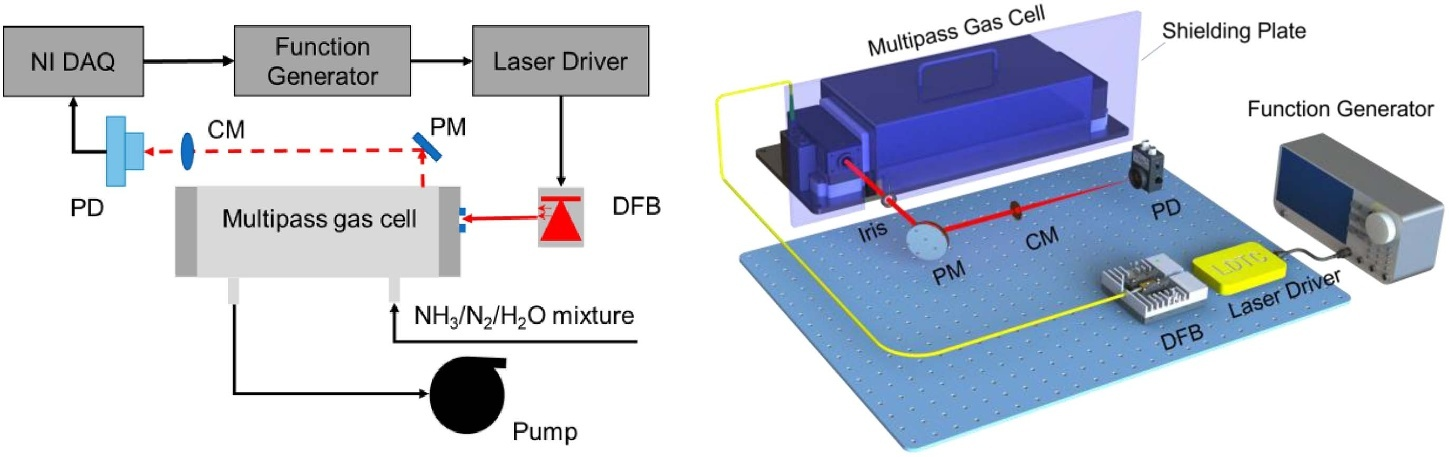
A near-infrared semiconductor laser and a heated multipass cell combine direct absorption and wavelength modulation spectroscopy to cover different ammonia-concentration ranges. Controlled humid mixtures quantify water-vapor broadening for measurement correction. Heated sampling is then applied to laboratory ammonia–methane flames and a co-fired industrial furnace.
Key findings
- Quantitative sensing was validated in controlled mixtures with 10–40% water vapor at 500 K and 1 atm. Above 20% water vapor, line broadening noticeably affected the modulation signal and required humidity correction.
- In the reported humid-gas stability test at 500 K, a minimum detection limit of 76 ppb was obtained with 140 s averaging. The detection limit without signal averaging was approximately 0.6 ppm.
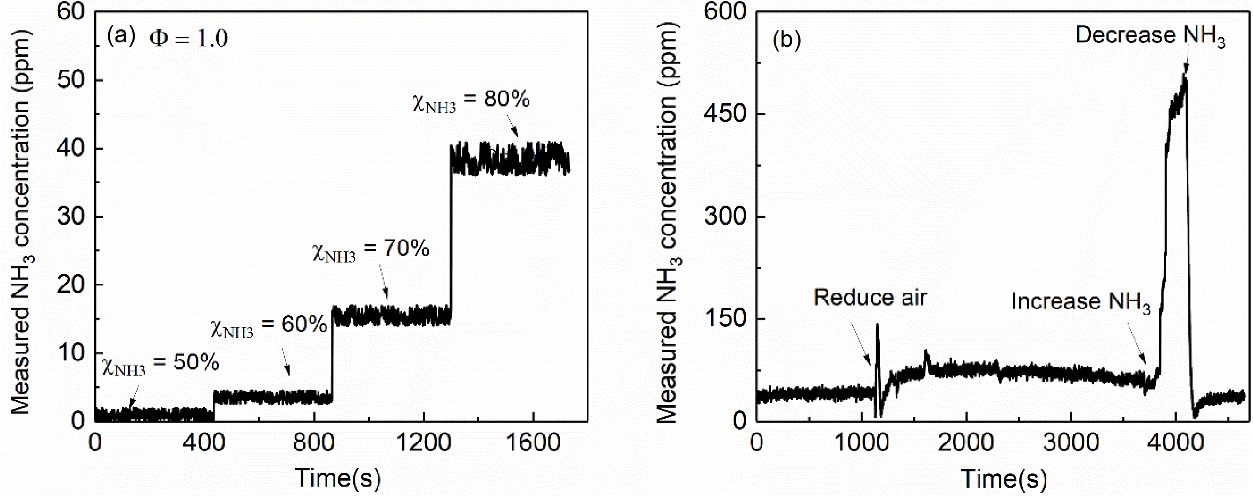
- The sensor tracked increasing ammonia slip as the ammonia fraction rose in laboratory flames. More than 4500 s of industrial-furnace monitoring captured changes in residual ammonia caused by adjustments to air and ammonia supply.
About this paper
Measurement Science and Technology · 2023 · 34(9) · 094005
Publisher record (DOI)