
Applied Thermal Engineering · 2026
Heat recirculation and air staging reduce NO in pure-ammonia combustion
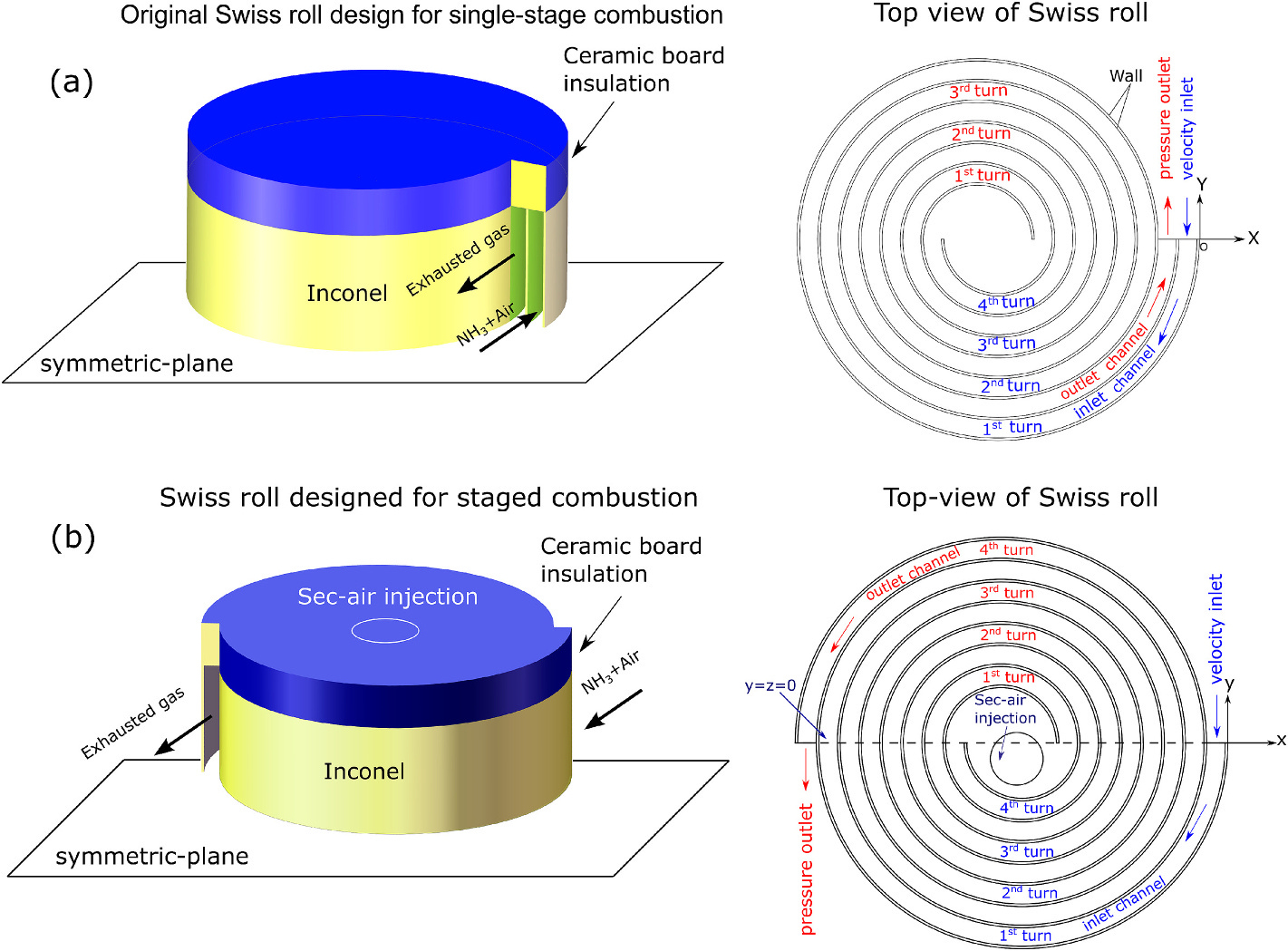
Staged ammonia-air combustion in a heat-recirculating Swiss-roll burner
Heat recirculation and air staging offer ways to use low-reactivity fuels efficiently with lower emissions. This study explores how Swiss-roll burner design can reconcile ammonia flame stability with NO control.
The motivation
Ammonia offers a carbon-free fuel option, but its low reactivity makes fuel-rich flame stabilization difficult. Measures that intensify combustion can also increase NO formation. This study uses heat recovered through spiral channels to support a rich primary flame and examines how downstream air injection can complete burnout with limited additional NO.
The approach
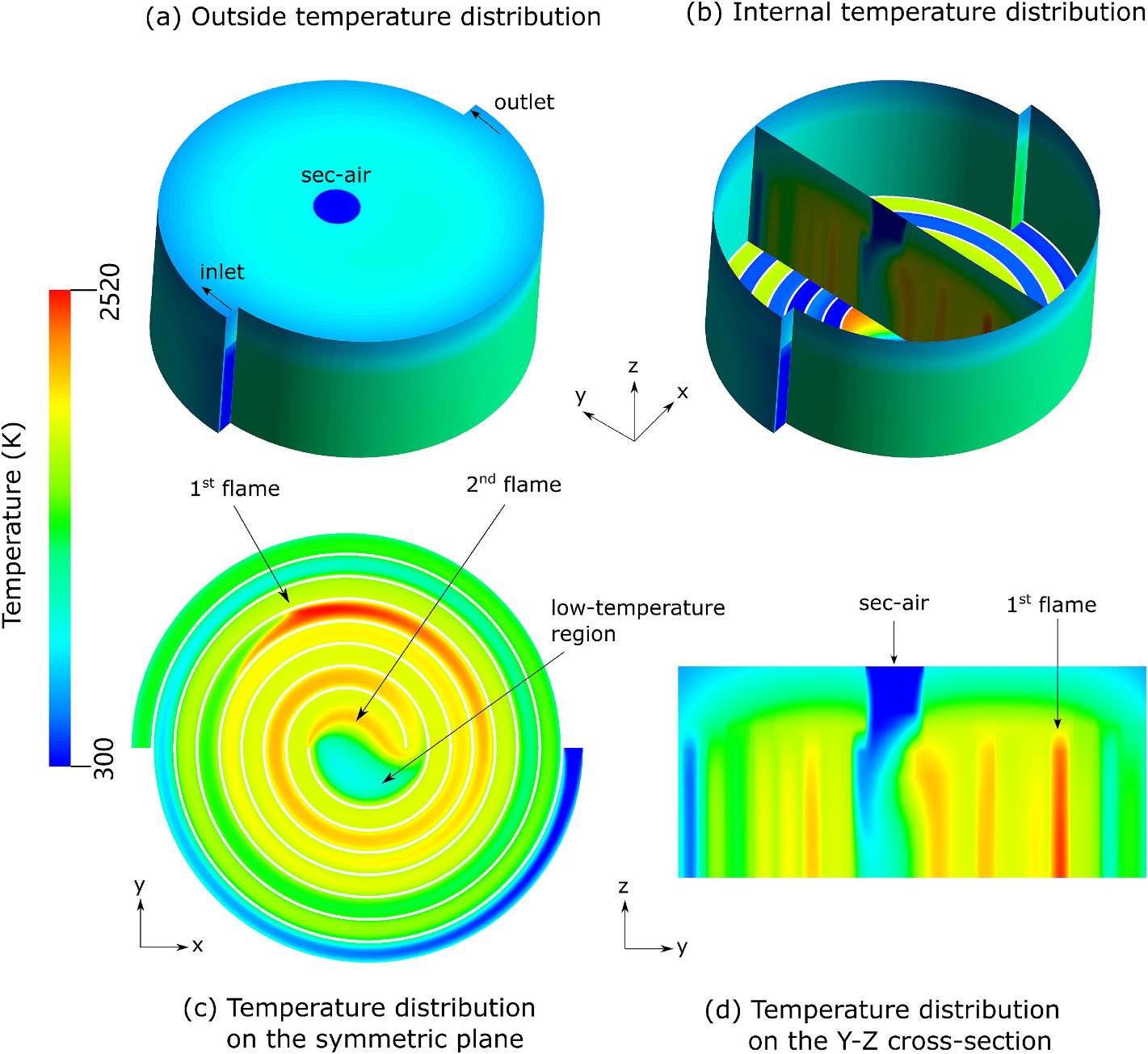
A three-dimensional numerical model accounts for turbulence, conjugate gas–solid heat transfer, radiation and ammonia reaction kinetics. At atmospheric pressure and an inlet temperature of 300 K, single-stage and air-staged combustion are compared. Thermal power and primary and global equivalence ratios are varied to examine flame structure, reaction pathways and outlet emissions.
Key findings
- The simulations show that the fuel-rich primary stage suppresses fuel-bound nitrogen conversion to NO while promoting ammonia consumption and partial decomposition. Downstream air completes oxidation at a comparatively lower temperature, limiting additional NO formation.
- At 3.0 kW, a primary equivalence ratio of 1.8 and a global equivalence ratio of 0.6, predicted outlet NO is approximately 65 ppm on a dry basis corrected to 15% O₂, with effective control of ammonia and hydrogen slip.
- The primary equivalence ratio associated with minimum NO shifts from approximately 1.7 at 3.0 kW to 1.9 at 4.0–5.0 kW. Air distribution and the primary flame thermal state therefore need to be adjusted together, rather than simply increasing combustion intensity.
About this paper
Applied Thermal Engineering · 2026 · 303 · 132174
Publisher record (DOI)