
Review of Materials Research · 2026
Materials and system design for industrial heating with partially cracked ammonia
Partially cracked ammonia as a carbon-free fuel for high-temperature industries: A material-centric review
Partial cracking turns ammonia into a more reactive ammonia–hydrogen fuel for high-temperature industrial heating. This review examines the material and system-design challenges on the path to industrial use.
The motivation
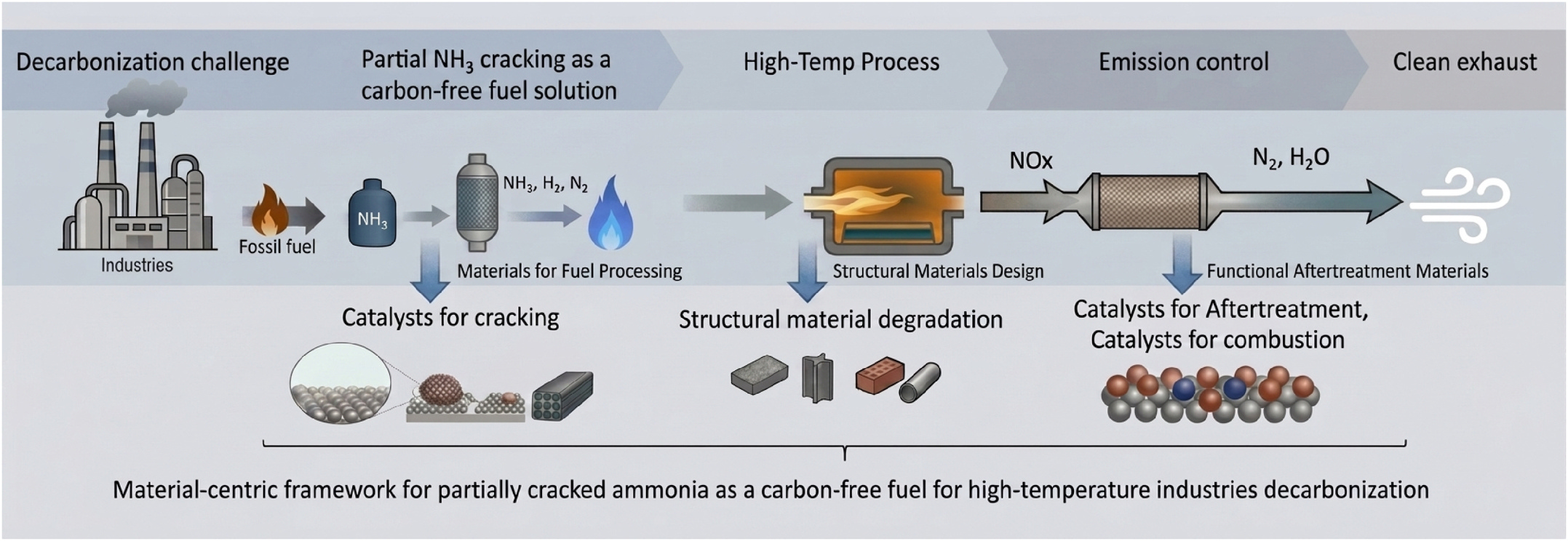
High-temperature furnaces and kilns require not only heat input but also flame-driven radiation, convection and process control. Ammonia offers storage and transport advantages and contains no carbon, yet direct combustion presents ignition, stability and NOₓ-control challenges. Partial cracking supplies hydrogen to improve combustion while introducing additional demands on catalysts, equipment materials and system integration.
The approach
This is a literature review. It first examines the thermodynamics and kinetics of partial ammonia cracking and the combustion characteristics of the resulting fuel blends. It then evaluates cracking catalysts and reactors, flue-gas treatment materials and high-temperature structural materials, identifying application limits and gaps in validation under industrial cycling and coupled service conditions.
Key findings
- The highest cracking fraction is not necessarily optimal. Flame stability, cracking heat demand, flashback, NOₓ, ammonia slip and system complexity must be balanced; industrial heating requires controlled hydrogen enrichment rather than complete conversion in every case.
- High moisture, residual ammonia and possible impurities in ammonia-combustion exhaust can expose deNOₓ catalysts to combined hydrothermal aging, poisoning and deposition. The review identifies simplified, single-factor tests as insufficient for assessing practical service performance.
- Structural materials may face nitridation, hydrogen-related damage, steam-assisted oxidation and coupled corrosion. The review calls for long-term assessment under realistic atmospheres, thermal cycling and stress, together with coordinated selection of catalysts, reactors and protective materials.
About this paper
Review of Materials Research · 2026 · 2 · 100293
Publisher record (DOI)